
Introduction
When you admire a piece of Jaipur print fabric, you're not just looking at a beautiful design—you’re witnessing the outcome of a meticulous, hands-on process refined over generations. The techniques behind Jaipur print are a stunning marriage of art, patience, and precision. From the carving of wooden blocks to the placement of each motif on the cloth, every step is rooted in tradition and executed with deep craftsmanship. This blog explores how Jaipur’s iconic prints are made, the tools involved, and the artistic elements that bring them to life.
The Foundation: Hand Block Printing
The soul of Jaipur print lies in hand block printing—an age-old technique practiced primarily in towns like Sanganer and Bagru, each with their distinct identity.
1. Preparing the Fabric
Before the fabric is even printed, it goes through several pre-treatment steps:
Desizing: The cotton or silk fabric is soaked in water or a mild bleach to remove starch and oils.
Harda Treatment: The cloth is then treated with Harda (a natural tannin from the myrobalan fruit) which ensures better dye absorption and helps bind natural pigments to the fibers.
The fabric is then sun-dried, ironed flat, and laid out on long tables—ready for printing.
Carving the Blocks: Art in Wood
The printing blocks are hand-carved from teakwood or sheesham (Indian rosewood). Each block is:
Soaked in oil for days to soften the wood.
Etched with the design using chisels and hammers.
Aligned perfectly with pegs for multi-color registration.
Every color in a pattern has its own separate block. A single motif might require three or more blocks—one for the outline (rekh), one for the fill (datta), and one for fine detailing (gud).
These blocks are passed down through generations, often becoming heirlooms in artisan families.
The Printing Process
Once the fabric and blocks are ready, the printing begins:
1. Dye Trays and Pads
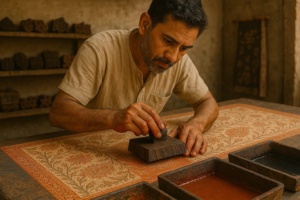
Natural or vegetable-based dyes are poured into wooden trays lined with felt pads. The block is pressed gently onto the dye-soaked pad to absorb an even amount of color.
2. Stamping the Fabric
With years of experience and a steady hand, the artisan stamps the block onto the fabric with a precise thump. This sound is not just auditory—it ensures good dye transfer and alignment.
The printer repeats this across the fabric with minimal error, carefully registering overlapping colors and intricate patterns.
3. Multi-Color Designs
Multi-colored patterns require drying time between each color layer. The alignment is done entirely by hand, block to block—an exercise in patience and perfection.
Motifs That Tell Stories
The motifs used in Jaipur print aren’t arbitrary. They reflect:
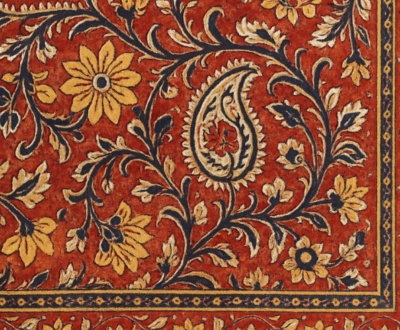
Nature: Floral vines, peacocks, mangoes (kairi/paisley), sunbursts, and lotus flowers.
Symbolism: The elephant symbolizes royalty, while the kalga (a curved motif) signifies fertility.
Geography: River waves, desert flora, and fort-inspired geometries are often woven into the pattern narratives.
Each town has its signature:
Sanganeri prints are known for delicate floral patterns on white or pastel backgrounds.
Bagru prints use mud resist printing and rely on earthy tones like indigo, black, and rust.
Fixing the Colors
Once the printing is complete, the fabric is allowed to dry. Then, it undergoes color fixation:
Steaming or sun-drying to bind the dye to the fabric.
Boiling in a solution of water, alizarin, and other natural agents.
Washing and drying to remove excess dye and reveal the final brilliance.
This process ensures that the colors do not fade easily and the print retains its vibrancy.
Innovation Meets Tradition
While traditional methods remain sacred, Jaipur print artisans have started incorporating:
Screen printing for mass production.
New fabrics like modal silk, chiffon, and linen blends.
Despite innovation, most artisans still follow traditional practices—celebrating slow, sustainable fashion.
Conclusion
The techniques behind Jaipur print represent more than just surface design—they're a testament to generations of artistry, discipline, and cultural preservation. Each piece tells a story—not just through its motifs, but through the hands that shaped it. As we grow more conscious of sustainable textiles and ethical fashion, Jaipur print stands out as a shining example of tradition thriving in a modern world.
ontemporary motifs like abstract lines, animals, or even digital reinterpretations of classics.
More from our blog
See all posts
Recent Posts
- Fabric Finshing Center in Jaipur |Fabric Finishing Services| December 17, 2025
- Fabric Stentering Service In Sanganer December 9, 2025
- Fabric Printing Services in Jaipur December 1, 2025
Pingback: online safety protocol
Pingback: orlistat contraindication information
Pingback: vardenafil cautionary factors
Pingback: vardenafil onset timing
Pingback: vardenafil’s physiological mechanism
Pingback: vardenafil food guidelines
Pingback: sildenafil safety assessment
Pingback: minoxidil faq hub
Pingback: ivermectin questions
Pingback: toradol migraine clinical use
Pingback: terbinafine nail fungus full overview
Pingback: acyclovir costs
Pingback: tadalafil dapoxetine tab
Pingback: sildenafil citrate average dose
Pingback: does doxycycline hyclate cause diarrhea
Pingback: does levitra work
Pingback: semaglutid tabletter uten resept
Pingback: hello world
Pingback: Fabric Printing Services in Jaipur